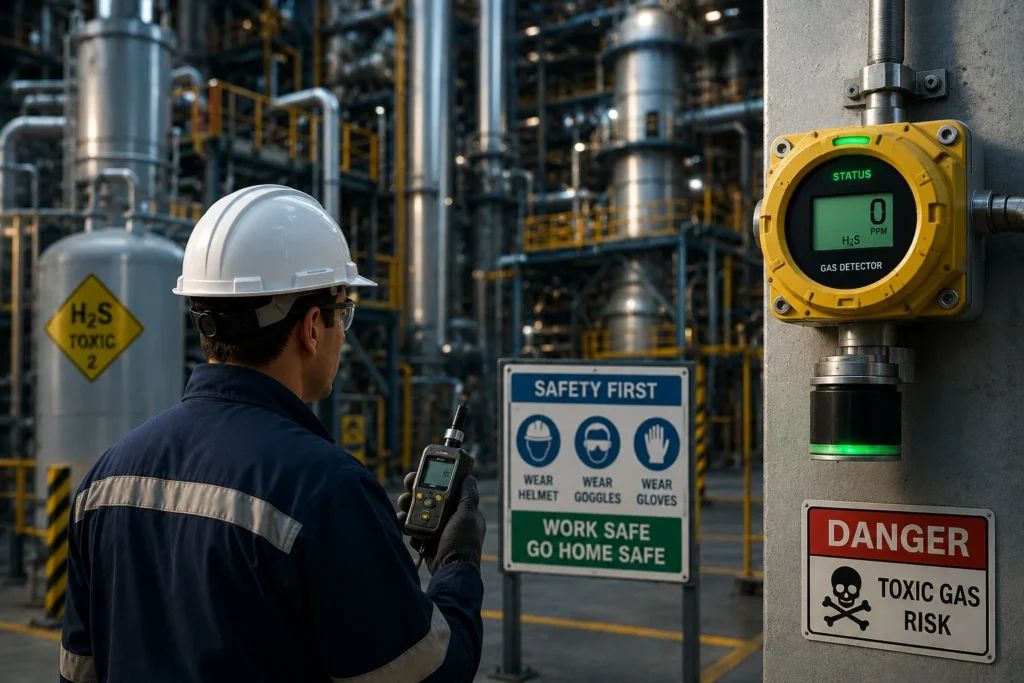
Gas hazards can be invisible, odorless, and potentially dangerous. In industrial environments, relying on human senses or portable detection alone may not provide sufficient protection. A Fixed Gas Detection System provides continuous monitoring of designated areas and can alert personnel when hazardous gas concentrations reach predefined levels.
For facilities where toxic, combustible, or oxygen-deficient atmospheres may occur, selecting and installing the right gas detection system is an important part of an effective industrial safety strategy.
SafeU Solutions provides gas detection and industrial safety solutions in Egypt for a wide range of industrial and high-risk applications.
What Is a Fixed Gas Detection System?
A Fixed Gas Detection System is a permanently installed gas monitoring solution designed to continuously detect specific gases in defined areas.
Unlike a portable gas detector that is normally carried by an individual worker, a fixed gas detection system remains installed in a specific location and continuously monitors the surrounding atmosphere.
A typical system may include:
- Fixed gas detectors
- Gas detection control panels
- Audible and visual alarms
- Relay outputs
- Remote indicators
- Emergency shutdown interfaces
- Ventilation system integration
- Industrial communication interfaces
Depending on the application, the system can detect combustible gases, toxic gases, oxygen deficiency, or oxygen enrichment.
How Does a Fixed Gas Detection System Work?
A fixed gas detection system generally operates through several stages:
1. Gas Detection
A detector continuously monitors the atmosphere around its installation point.
Depending on the detector and application, the sensor may detect gases such as:
- Methane (CH₄)
- Propane (C₃H₈)
- Hydrogen (H₂)
- Carbon Monoxide (CO)
- Hydrogen Sulfide (H₂S)
- Ammonia (NH₃)
- Oxygen (O₂)
- Other toxic or combustible gases
2. Signal Transmission
When the detector measures the gas concentration, it sends the measurement or alarm signal to the appropriate control equipment.
Depending on the system architecture, communication may use:
- 4–20 mA
- Relay outputs
- Digital communication
- Addressable communication
- Other industrial protocols
3. Alarm Activation
If the gas concentration reaches a predefined alarm level, the system can activate connected warning devices.
These may include:
- Sounders
- Beacons
- Visual alarms
- Control room alarms
- Remote indicators
4. Safety System Integration
In more advanced installations, the gas detection system can be integrated with other safety systems.
For example, an alarm condition may initiate:
- Ventilation
- Equipment shutdown
- Emergency procedures
- Process isolation
- Control room notification
The exact response depends on the facility’s safety philosophy and system design.
Why Are Fixed Gas Detection Systems Important?
Gas leaks can develop without immediate visual warning. A continuous monitoring system provides an additional layer of protection by detecting hazardous atmospheres before they become more dangerous.
A properly designed system can help organizations:
Protect Personnel
Workers may be exposed to toxic or combustible gases without immediately realizing it. Continuous monitoring provides early warning when hazardous conditions develop.
Reduce Fire and Explosion Risks
Combustible gases can form explosive atmospheres when they reach certain concentrations. Fixed gas detection can provide early warning and support appropriate emergency responses.
Protect Equipment and Facilities
Gas leaks can result in fires, explosions, corrosion, or other operational incidents. Early detection can help reduce potential damage.
Support Emergency Response
Audible and visual alarms can alert personnel and safety teams to investigate and respond to hazardous conditions.
Improve Operational Safety
Gas detection can become an important component of an overall industrial safety and process protection strategy.
Fixed Gas Detector vs Portable Gas Detector
Both systems are important, but they serve different purposes.
| Feature | Fixed Gas Detection | Portable Gas Detection |
|---|---|---|
| Installation | Permanently installed | Carried by worker |
| Monitoring | Continuous | During worker operation |
| Coverage | Defined area | Individual worker / work area |
| Alarm | Local and/or remote | Device alarm |
| Integration | Can integrate with safety systems | Usually standalone |
| Typical Use | Facility monitoring | Personal protection |
| Mobility | Fixed location | Portable |
For many industrial applications, fixed and portable gas detection should be considered complementary rather than competing technologies.
A fixed system can continuously monitor critical areas while portable detectors provide personal protection for workers entering potentially hazardous locations.
Where Are Fixed Gas Detection Systems Used?
Fixed gas detection systems can be used in a wide range of industrial and commercial environments.
Oil & Gas
Gas detection is particularly important in facilities where hydrocarbons and toxic gases may be present.
Applications can include:
- Oil & gas processing facilities
- Refineries
- Storage areas
- Gas stations
- Compressor stations
- Pipeline facilities
- Tank farms
- Loading and unloading areas
Chemical and Petrochemical Plants
Chemical processes may involve toxic, flammable, or oxygen-displacing gases.
Fixed detection can provide continuous monitoring around:
- Process areas
- Storage tanks
- Chemical handling areas
- Production units
- Pump rooms
Boiler and Utility Rooms
Combustible gases may accumulate in areas containing gas-fired equipment.
Fixed gas detection can be used to monitor potential gas leaks and support alarm and ventilation strategies.
Battery Charging Rooms
Certain battery technologies can generate hydrogen during charging.
A properly selected gas detection solution can monitor hydrogen concentrations where required by the application and safety assessment.
Wastewater Treatment
Wastewater facilities can generate gases such as hydrogen sulfide and methane.
Fixed gas detection can be particularly important around:
- Treatment areas
- Pump stations
- Manholes
- Sludge processing
- Confined spaces
Manufacturing Facilities
Industrial processes can involve combustible or toxic gases.
Fixed detection may be used around production equipment, gas storage, cylinder areas, and other locations where a gas release could occur.
Types of Fixed Gas Detectors
Selecting the right detector depends on the gas, environment, application, and required performance.
Combustible Gas Detectors
These detectors are designed to detect combustible gases and commonly report concentration in relation to the Lower Explosive Limit (LEL).
Examples include:
- Methane
- Propane
- Hydrogen
- Natural gas
Toxic Gas Detectors
These detectors monitor gases that may be harmful to personnel even at relatively low concentrations.
Common examples include:
- Carbon Monoxide
- Hydrogen Sulfide
- Ammonia
- Chlorine
- Sulfur Dioxide
Oxygen Detectors
Oxygen detection can be used where oxygen deficiency or enrichment presents a safety risk.
Oxygen-deficient atmospheres can be particularly hazardous because workers may not recognize the danger without instrumentation.
How to Choose the Right Fixed Gas Detection System
Selecting a gas detection system should not start with the detector price.
The first step is understanding the application.
1. Identify the Gas
Determine which gas or gases need to be detected.
The detector must have an appropriate sensor technology and measurement range for the target gas.
2. Determine the Hazard
Is the primary concern:
- Toxic exposure?
- Fire?
- Explosion?
- Oxygen deficiency?
- Oxygen enrichment?
The answer affects the type of detector and alarm strategy.
3. Assess the Environment
Consider:
- Indoor or outdoor installation
- Temperature
- Humidity
- Dust
- Corrosive atmosphere
- Ventilation
- Potential mechanical impact
4. Consider Hazardous Area Classification
For hazardous locations, the detector and associated equipment may need appropriate approvals and certifications for the classified area.
This is particularly important in oil & gas, petrochemical, chemical, and other potentially explosive atmospheres.
5. Determine Detector Location
Detector placement is critical.
Installing a high-quality detector in the wrong location may significantly reduce the effectiveness of the system.
Gas characteristics, density, ventilation patterns, potential leak sources, and facility layout should all be considered when determining detector locations.
6. Determine Alarm Levels
Gas detection systems may use multiple alarm thresholds.
The appropriate alarm levels depend on the gas, application, applicable standards, risk assessment, and facility safety requirements.
7. Consider Integration Requirements
Determine whether the system needs to communicate with:
- Fire alarm systems
- Emergency shutdown systems
- PLCs
- SCADA
- Building management systems
- Ventilation systems
- Control room systems
Fixed Gas Detection Control Panels
A control panel acts as the central monitoring point for many fixed gas detection installations.
Depending on the system architecture, the panel can:
- Monitor connected detectors
- Display gas concentrations
- Display alarm conditions
- Monitor faults
- Activate relays
- Control alarms
- Communicate with other systems
For larger facilities, the control system may support multiple detectors and multiple zones.
Alarm and Relay Outputs
Relay outputs are commonly used to connect the gas detection system to other equipment.
For example, a gas alarm can be used to activate:
Gas Detector → Control Panel → Relay → Ventilation / Alarm / Shutdown
This allows gas detection to become part of a broader safety response rather than simply displaying a gas concentration.
The exact configuration should always be designed according to the facility’s engineering and safety requirements.
Calibration and Maintenance
Even the best gas detection equipment requires appropriate maintenance.
Sensors can experience changes in performance over time depending on the technology and operating environment.
A maintenance program may include:
- Visual inspection
- Functional testing
- Alarm testing
- Calibration
- Sensor replacement
- Verification of outputs
- Control panel testing
- Inspection of wiring and connections
Calibration intervals should follow the manufacturer’s recommendations and the site’s risk assessment, operating conditions, and applicable requirements.
Why Calibration Matters
A detector that is not properly maintained may provide inaccurate measurements.
Regular testing and calibration help verify that the detector responds correctly to the target gas and that alarm functions operate as intended.
Fixed Gas Detection System Standards
The applicable standards and certifications depend on the system, industry, country, and hazardous area classification.
Depending on the application, engineers may need to consider standards and requirements related to:
- Gas detection
- Functional safety
- Explosive atmospheres
- Electrical installations
- Fire and life safety
- Hazardous area equipment
For hazardous areas, certifications such as ATEX or IECEx may be relevant depending on the installation requirements.
Always verify the exact certification requirements before selecting equipment.
Common Gas Detection System Mistakes
Several mistakes can reduce the effectiveness of a gas detection system.
Choosing Based Only on Price
The cheapest detector may not be the most appropriate solution for the application.
Incorrect Detector Placement
Gas behavior and ventilation must be considered when determining installation locations.
Using the Wrong Sensor
Different gases require different detection technologies.
Ignoring Hazardous Area Requirements
Equipment installed in classified hazardous areas must meet the applicable requirements.
Poor Maintenance
A gas detection system should be regularly inspected, tested, and maintained.
No Emergency Response Plan
Detecting gas is only part of the safety process. Personnel should understand what to do when an alarm occurs.
Fixed Gas Detection System in Egypt
Industrial facilities in Egypt operate across many sectors where gas detection may be required, including:
- Oil & Gas
- Petrochemical
- Manufacturing
- Construction
- Marine
- Utilities
- Food and beverage
- Water and wastewater
- Chemical processing
- Energy
Selecting a suitable Fixed Gas Detection System in Egypt requires understanding the actual application rather than simply selecting a product from a catalog.
Factors such as the gas type, installation environment, hazardous area classification, detector location, communication requirements, alarm philosophy, and applicable standards should all be evaluated.
Why Choose SafeU Solutions?
SafeU Solutions provides industrial safety and gas detection solutions for companies operating in Egypt.
Our product portfolio includes solutions for:
- Portable Gas Detection
- Fixed Gas Detection
- Multi-Gas Detection
- Personal Gas Monitoring
- Industrial Safety Equipment
- PPE
- Firefighting Equipment
- Electrical Safety
- Fall Protection
We work with customers to identify suitable equipment based on their application, required specifications, and operational environment.
Whether you are looking for a single fixed gas detector, a multi-point monitoring system, or a complete Fixed Gas Detection System, our team can assist with product selection and technical requirements.
Get the Right Gas Detection Solution
A fixed gas detection system should be treated as an important component of the facility’s overall safety strategy.
The right solution depends on much more than the detector itself.
Gas type + application + environment + detector location + certification + alarm strategy + maintenance = effective gas detection.
If your facility requires continuous monitoring of combustible, toxic, or oxygen-related hazards, SafeU Solutions can help you identify an appropriate gas detection solution.
SafeU Solutions
Industrial Safety | Gas Detection | PPE | Firefighting Solutions
📧 info@safeusolutions.com
📞 +20 150 364 4055
Looking for a Fixed Gas Detection System in Egypt? Contact SafeU Solutions for product recommendations and quotations.
#FixedGasDetectionSystem #FixedGasDetector #GasDetectionSystem #GasDetector #GasDetection #IndustrialSafety #GasMonitoring #OilAndGas #HSE #SafetyEquipment #PPE #Egypt #SafeUSolutions